C.L.O.C.K. Accountability · Flock · Public Trust
Georgia’s misuse cases make verifiable safeguards essential. Appling’s documented records-law failure makes accountability urgent.
1. Short Story
A tag light. A cracked or chipped windshield. If an equipment defect violates Georgia law, something that small can put you on the side of the road answering to a deputy. [R13]
We are expected to follow the law. Fair enough.
So is the office enforcing it.
On August 19, I sent the Appling County Sheriff’s Office two records requests about Flock. One asked how the system was bought, paid for, and put into use. The other asked what rules govern it, who can use it, and how the office checks that use. [R1: S1–S2]
The office sent a policy and a revised response. But the buying and deployment records remained outstanding in the correspondence reviewed for this article. After repeated reminders, the office still had not given the production timeline Georgia law requires. Its September 18 answer promised a response when all seven categories were finished. That is a documented failure to meet the law’s timeline requirement. The office had been told what the statute requires and still supplied no dates. [R1: S8–S9, S11–S13] [R9: § 50-18-71(b)(1)(A)]
Georgia’s own investigations show why this matters. The GBI reported that an Albany Police Department audit found officers repeatedly using Flock data for non-law-enforcement purposes; five former officers were arrested and charged. It also announced misuse charges involving personnel from the Clayton, Colquitt, and Hall County sheriff’s offices. These are official audit findings and arrest-and-charge announcements, with differing case statuses. They establish neither convictions nor misuse in Appling. [R8]
Put those Georgia cases beside Appling’s record: searching documented before the supplied Flock policy, oversight assurances without supporting records located, and the missing production timeline after explicit reminders. Those are the reasons to demand verifiable safeguards here. Residents should not have to prove a hidden scandal before the office answers basic questions about its work. [R1: S13] [R2: items 8–9, page 2] [R3] [R5] [R8] [R9]
Give us a reason to trust you. Follow the law governing your own office. Produce the records that let us check how this authority is being used.
2. Why This Matters
Georgia’s misuse cases make transparency a safeguard
This concern has already produced criminal cases in Georgia. In Albany, the GBI said an internal audit revealed repeated use of retained Flock plate data for non-law-enforcement purposes. Its July 6 announcement records the arrests and charges against five former officers. In Hall County, a Flock audit led to an investigation and a September 30 arrest announcement; the GBI described its information about non-law-enforcement access as preliminary. [R8: Albany; Hall]
Those cases show why access rules, meaningful audits, and records supporting training and supervision deserve scrutiny. The audits that uncovered the reported conduct also show that oversight can work. Appling’s office reports monthly reviews and no known or suspected misuse, but says no responsive records or written documentation were located for that subject. Show us what was reviewed, which period it covered, and what supports that assurance. [R8] [R2: item 8]
The connection to the records-law failure is direct. Residents need records to evaluate the safeguards around a powerful system. The office’s September 18 response left the required production timeline unmet after reminders. That failure makes confidence in its other assurances harder to sustain. This is a judgment about public trust grounded in the documented response; it does not turn the Georgia cases into evidence of Appling misuse. [R1: S8, S12–S13] [R2] [R9]
Why is the office leaving this legal requirement unmet? And why should residents accept unverified assurances about surveillance while that requirement goes unanswered? The office should explain its conduct and provide the records. Public trust has to be earned through actions people can check.
What Flock says, and what the evidence shows
Flock’s public article says its ALPR cameras “do not and cannot track vehicles, much less individual people.” It describes separate snapshots rather than movement tracking. That is what the company tells the public. [R17]
Now put that beside the evidence.
InvestigateTV reviewed Flock training videos describing how officers can reconstruct movement between places. One officer described following a suspect into another state. Flock’s spokesman drew a distinction between a history of sightings and continuous observation. Residents deserve to know how much those sighting histories can reveal. [R18]
Flock’s media FAQ describes still photographs of vehicles and says its ALPR cameras do not identify occupants or use facial recognition. Its security notice also says someone gaining physical access to a device “would still not be able to gain access to footage,” because data remains there only briefly after transmission to the cloud. [R11] [R19: Flock security notice]
WIRED and 404 Media’s September 16 investigation found person-detection software and 27,321 stored video clips on one ALPR camera. The clips ran about one to two seconds, alongside separate still-image bursts. Tests detected people. The examination found no active facial recognition. Detecting a person is different from identifying that person. Flock told the reporters it lacked enough information to assess their security claims and invited formal reporting. Stored clips do not establish customer access to video, and the researchers did not examine Appling’s cameras. [R19: camera examination]
The public description and the examined device need to be reconciled. What gets captured, what remains on a camera, what reaches the cloud, and what an officer can retrieve are separate questions. Device versions and settings matter. A general assurance cannot substitute for identifying Appling’s equipment and documenting its actual behavior. [R1: S1] [R11] [R19]
Flock also tells the public that customers control their data. But control depends on more than an assurance. The ACLU’s April contract analysis raised concerns about data-use and access rights. We checked the dated terms behind that analysis against the current terms; the differences are another reason to demand Appling’s actual signed agreement. [R11] [R24]
InvestigateTV also demonstrated a Condor camera following a walking reporter. Flock described that behavior as movement detection within the camera’s view. Condor is a separate video product. That distinction matters when somebody says “Flock cameras” as though every camera and every feature were the same. [R18]
WIRED’s separate examination of OS Investigate interface code described searches for vehicles regularly seen in an area and inferred associates. Flock said the product was still being tested and could change. Interface code shows intended functions; it does not prove they all worked in a live system. [R20]
A string of pictures can tell a story about where you have been. The system does not have to recognize your face or watch every minute of your day for travel history to deserve serious scrutiny. The movement described in Flock’s training is why this question matters. [R18]
There is also evidence of what officers search for. The Intercept’s September 9 investigation reported more than 1,200 searches categorized as “Curfew/Loitering/Vagrancy Violations” in records supplied by Plano, Illinois. Its September 10 correction makes clear that these were not all searches of Plano’s own cameras: the records began before those cameras were installed. Many queries came from other agencies. [R23]
The report describes a Norcross, Georgia search spanning 6,098 camera networks, and a LaGrange search spanning more than 15,000 systems because someone was “lingering at a stop sign around midnight last night.” These are reported search scopes, not counts of people tracked or confirmed matches. The reporter says most reviewed loitering searches lacked case numbers. That does not, by itself, establish that a search was unlawful. Nor do the entries establish facial identification or the complete circumstances of each investigation. [R23]
What rule keeps a nationwide travel-history search from becoming the first response to somebody merely looking suspicious? That is a question about actual use and supervision. It belongs beside the company’s descriptions of capability—and beside our request for the records showing how Appling controls access and checks searches. [R1: S2] [R23]
The Oklahoma ruling gives the pretext concern a concrete example
On October 1, Judge Sara E. Hill of the Northern District of Oklahoma granted suppression in United States v. Melisa Susan Kyle, No. 4:26-cr-00189-SEH, ECF 62. [R22: pages 1, 38]
The deputy began following a car after seeing its California plate and searched Flock and VehicleManager before observing the later traffic violations. He entered “traffic violation” and “investigation” as search reasons when the plate’s state was all he knew. His historical search supplied a month of locations, with more than fifty sightings across states. He then observed traffic violations. [R22: pages 2–4, 34, 37]
That is a documented example of the sequence behind our concern: select a car, follow it while searching its past, then stop it for a traffic violation. It gives the pretext theory a factual example; it does not establish Appling’s practices.
The judge found an objectively valid traffic basis for the stop, but held the earlier warrantless history search unconstitutional and suppressed all evidence obtained after it began. She separately found the later detention unsupported by reasonable suspicion. The order calls the network’s collection “indiscriminate mass surveillance.” [R22: pages 10–11, 25–29, 34, 37–38]
This decides one Oklahoma case. The order acknowledges contrary decisions; it does not ban every Flock use or decide Appling’s compliance. Its relevance here is concrete: a traffic violation does not answer the constitutional question about the surveillance that led an officer to that car. [R22: pages 29–30, 37–38]
What we can establish in Appling
I cannot confirm that Appling has Condor, OS Investigate, or every feature in those investigations. That is one reason the purchase and deployment records matter. We need to know what this office actually bought and switched on. [R1: S1] [R16]
What we do have is an April 22, 2025 audit entry attributing a search to Appling County GA SO. Its scope covered 6,248 networks and 80,271 devices. Those numbers describe where the search looked; they do not count successful matches or vehicles caught on camera. [R5]
We also searched again for an advance public explanation. The October 3 review covered targeted web searches and OCR of 24 county meeting PDFs, totaling 113 pages, under the August 2024–July 2026 archive entries. Four pages received targeted visual checks. We did not locate Flock or plate-reader discussion in those meeting documents. I cannot confirm that residents were never consulted or that commissioners were never notified. Minutes and public searches cannot tell us every private conversation. [R21]
There is an earlier public record: a Georgia DOT approval list released in May 2025 records approval for two Sheriff’s Office cameras on October 2, 2024. It does not name the vendor or establish when residents were told. Jamie Gardner’s August 2026 newspaper article also describes months of community discussion. We cannot honestly call that article the first public disclosure. The question remains: when did the office explain this system to the people living under it? [R21: GDOT, Tab 1, A89:F89] [R4]
The Sheriff is an independently elected constitutional officer. The County Commission has budget responsibilities, but it does not run the Sheriff’s law-enforcement decisions like a department under its direct supervision. That puts a great deal of weight on public trust. An independent office must give the public a reason to trust how it uses that independence. Its legal duties still apply. Following them and showing its work are basic expectations of the county’s head law-enforcement office. [R12] [R9] [R10]
The office’s own response says no Flock-camera policies existed before July 28, 2026. The Sheriff’s newspaper account places the first two cameras fully installed in early 2025. The documented April 22 search came 462 days—fifteen months and six days—before the policy date. That is the interval between two records, not a confirmed activation date or proof of uninterrupted camera use. [R2: page 2] [R3] [R4] [R5]
Georgia law says a deploying agency “shall maintain policies for the use and operation” of its ALPR system, including policies for officer training in lawful use of captured plate data. “Shall” makes this a duty. The law supplies no grace period to operate first and put policies in place later. Reading it to require policies during deployment and operation follows that wording; the statute does not literally say “prior to activation.” [R10: § 35-1-22(e)]
What satisfied that duty before July 28? If a broader office policy governed Flock, identify it, show its effective date, and produce it. My original request already asked for broader policies. The supplied records have not settled this question. [R1: S2] [R2: page 2] [R10]
Training has its own gap. The office reported Flock webinars but located no records of their dates or times. Its delivery email said it does not maintain those records and that I could seek the details from Flock. The records supplied do not establish who was trained, when, or how completion was checked before access. The statute expressly requires training policies; it does not expressly require creation of webinar attendance records. I cannot confirm a separate attendance-record violation from that provision alone. But an unverified training account still needs an answer. [R2: item 9] [R1: S2, items 9, 13; S9] [R10]
The missing production timeline is an established failure in the reviewed correspondence. The office was reminded of the requirement and still supplied none. A promise to answer when the work is finished does not meet the timeline requirement. Georgia law requires that timeline for existing records unavailable within three business days. Why did the Sheriff’s Office leave that duty unmet after explicit reminders? I cannot confirm the reason. The failure itself is in the record. [R1: S8, S12–S13] [R9: § 50-18-71(b)(1)(A)]
If residents must answer for a light bulb, the Sheriff’s Office can answer for its own statutory duties. Georgia’s documented misuse cases raise the stakes for verifiable safeguards. The office asking residents to trust its use of surveillance must demonstrate that it follows the laws governing its own conduct. [R8] [R1] [R9]
How travel history could affect an ordinary resident
Say your daily route to work passes a suspected drug house. A camera history might draw an officer’s attention. It does not prove you went inside or broke the law. This is an example of the concern, not a claim about an identified Appling stop.
The Supreme Court has said that being in an area of expected crime, by itself, does not establish reasonable suspicion. Courts consider the whole situation, and an innocent explanation does not automatically defeat otherwise supported suspicion. Those cases do not decide this exact Flock example. [R14: Wardlow; Arvizu]
An officer could use a sighting history to choose a car to watch, then stop it for an actual traffic violation. Under Whren, probable cause for that violation can support the stop even with another investigative purpose in mind. A court record from Wyoming describes a deputy following a vehicle about 50 miles before another speeding stop; the majority upheld the challenged action. That is a documented example of extended observation, not evidence of Appling’s practices. The Kyle order adds a separate question: whether the historical search used to select that car was itself lawful. [R14: Whren; Baker] [R22]
A lawful stop still does not automatically authorize a full search. Prolonging a traffic stop for an unrelated investigation needs additional justification. A vehicle search needs its own legal basis, such as voluntary consent or probable cause under the automobile exception. A home search generally requires a warrant, with recognized exceptions. Answers during an ordinary traffic stop can also be admissible without initial Miranda warnings. [R14: Rodriguez; Knowles; Bostick; Dyson; King; Berkemer]
The Fourth Amendment still applies. The question is how camera history influences who gets watched, questioned, followed, or stopped—and who checks those decisions.
3. Key Facts
| Date | What we can put a source beside |
|---|---|
| April 22, 2025 | A released audit record attributes a search to Appling County GA SO. It does not establish first use or camera activation. [R5] |
| July 28, 2026 | Date on the supplied Flock policy. The office says there were no earlier Flock-camera policies. [R2: page 2] [R3] |
| August 19, 2026 | I submitted two requests. Gardner’s newspaper article reported the Sheriff’s account of the cameras and safeguards. [R1: S1–S2] [R4] |
| August 25, 2026 | The first no-misuse assurance came when the supplied policy was 28 days old. [R1: S4] [R3] |
| August 31, 2026 | Date on the revised governance letter and the separate acquisition acknowledgment. [R1: S7] [R2] |
| September 15, 2026 | The office delivered the revised response and policy attachments. [R1: S9] |
| September 18, 2026 | The acquisition reply promised a response after all seven categories were gathered; it gave no production timeline. [R1: S13] |
| October 3, 2026 | No later agency reply was located in the bounded mailbox search. I subsequently sent a separate completion demand for each request. [R15] [R16] |
Here is the calendar math: July 28, 2026 minus April 22, 2025 = 462 days, or 15 calendar months and six days. August 25 minus July 28 = 28 days. October 3 minus the August 19 requests = 45 days; October 3 minus the August 31 acquisition acknowledgment = 33 days. These are elapsed calendar days, not calculations of statutory business-day deadlines. [R1] [R2] [R3] [R5]
4. What the Records Show
What we asked for, and what we received
The buying request had seven categories: purchase and service records, invoices, funding, approvals, deployment, data agreements, and system and recurring-cost records. The governance request had thirteen: use, access, searches, alerts, retention, sharing, reviews, training, discipline, vendor rules, and policy history. It included broader policies that might have governed earlier use. [R1: S1–S2]
The office did produce useful documents. Its July 28 policy prohibits personal use, requires a trackable case or call number for tag searches, calls for logging enforcement outcomes, and provides discipline for misuse. Those are real controls. The problem is what remains unanswered around them. [R1: S9] [R2] [R3: A.4–A.6]
| Subject | What the revised answer gives us | What we still need |
|---|---|---|
| Buying and deployment | Gathering is continuing; no acquisition production located in the reviewed correspondence | The records and a production timeline |
| Earlier rules | July 28 policy; office says no earlier Flock-camera policies | What governed earlier use |
| Access | “Flock Admin Staff”; a policy instruction about adding a vehicle | Account approval, permissions, authentication, termination, and outside access |
| Sharing | No responsive records located | Rules and decisions governing access in both directions |
| Reviews | Monthly reviews and no known or suspected misuse reported; supporting records not located | What was checked, under which standards, covering which period |
| Training | Flock webinars; no dates or times located | Requirements, materials, and evidence of implementation |
| Retention | Thirty days changing to seven, with an evidence exception; no written support | When the change happened and how preservation, exports, and deletion work |
This uses the revised answers, including the detail added after the first “N/A” responses. [R1] [R2: items 3, 6–9, 11–13] [R16]
A promise to finish is not a production timeline
The September 14 and September 18 follow-ups specifically identified the timeline requirement. The September 18 acquisition reply still gave no dates. [R1: S8, S11–S13]
Georgia’s Open Records Act requires available responsive records within a reasonable time, no more than three business days. If existing records are unavailable, the office must give a description and timeline and provide access as soon as practicable. Available records should come out while the remaining work continues. [R9: § 50-18-71(b)(1)(A)]
I cannot confirm why the office did not supply the timeline. I can establish that it did not, even after the obligation was pointed out. The office failed to follow this requirement of state law. Residents should not have to keep teaching the law to the office entrusted with enforcing it. [R1: S8, S12–S13] [R9]
The Sheriff’s Office is best placed to produce its records and explain its actions. If records resolve these gaps or correct this account, produce them. We will identify and incorporate supported corrections. A later production can resolve outstanding questions; it cannot change what the September 18 response said or add a timeline that was absent from that response. Change what the public can establish by supplying the evidence. Give us a reason to trust the office’s word. [R1: S13] [R16]
The policy date changes the public-trust question
Gardner’s August 19 Baxley News-Banner article reported Melton’s account of the first two cameras being fully installed in early 2025. It described a written policy, audits, and safeguards. It did not identify that policy’s effective date. [R4: continuation]
The later response supplied July 28, 2026 and said no earlier Flock-camera policies existed. The April 2025 audit entry documents searching 462 days before that date. What policies met the state-law requirement during the earlier period? A later policy does not answer that question. [R2: page 2] [R3] [R5] [R10]
I cannot confirm everything Gardner was told, what documents the reporter received, or whether anyone deliberately left information out. We can ask whether the policy date and the earlier safeguards were explained. The same history remains unresolved in the records supplied to me. [R1: S2] [R2] [R4]
The newspaper also attributed two cameras and four on order, a $3,350 camera cost, and $3,000 annual maintenance per camera to County Manager Reid Lovett. Those are dated reported figures. They are not checked invoices, a current installation count, or a reconciled contract total. The buying records should let us sort that out. [R4: opening page] [R1: S1]
What the 768 searches tell us
On October 3, Have I Been Flocked displayed 768 unique searches performed by Appling, with activity from April 22, 2025 through July 20, 2026. These are generally nationwide queries visible in other agencies’ released records. They are not 768 outside searches of Appling cameras, 768 drivers, or 768 successful matches. [R6]
The site warned that an import was in progress, identified August 8 as the latest import of this agency’s records, and still showed July 20 as the latest search despite its October 3 statistics update. I cannot confirm later activity or a complete lifetime total from that snapshot. [R6]
It labeled 538 searches as having no case number. The calculation is 538 ÷ 768 × 100 = 70.052083…%, rounded to 70.1%. That deserves an explanation. Missing or redacted fields do not prove an unlawful search, and the July 28 policy cannot simply be applied backward to earlier searches. Nor have we independently reconciled every record behind the aggregate. The preserved April entry provides its own dated evidence. [R6] [R3: A.6] [R5]
The question is what records linked those searches to legitimate law-enforcement work.
Who can get in, and who can share?
I asked for access rules: who may use the system, who approves accounts, permission levels, authentication, termination, supervision, and outside access. That request did not expressly demand a list of every named user. [R1: S2, item 3]
The revised answer pointed to “Flock Admin Staff” and A.7. But A.7 tells personnel whom to contact to add a vehicle. It does not explain most of those account controls. The office has not made clear whether “Flock Admin Staff” means its employees or the vendor’s. [R2: item 3] [R3: A.7]
Melton’s newspaper account said nine people could enter information, with two being removed that week. Entering information is only part of access. Who could search, get alerts, administer accounts, or use shared data? [R4: continuation]
On sharing, the revised answer said no responsive records were located. That does not mean there was no sharing. The supplied policy contains no express rules for approving, revoking, or controlling redisclosure of outside access. Flock says customers control sharing settings. So what records show Appling’s choices? [R1: S4, item 7] [R2: item 7] [R3] [R11]
The April search’s scope reached 6,248 networks and 80,271 devices. That does not prove hits or tell us which outsiders could see Appling data. It does support asking what governed Appling’s access to the wider system. Access in both directions needs an answer. [R5]
Who checked the checking?
The August 25 no-misuse assurance came when the supplied policy was only 28 days old. The revised response reported monthly administrator reviews and no known or suspected misuse, while saying no responsive records or written documentation were located for that subject. [R1: S4, item 8] [R2: item 8] [R3]
A review could happen before day thirty. Earlier reviews could also have existed. The date alone does not prove nobody checked anything. But it leaves the question that matters: did those reviews cover the earlier use, what rules did they apply, and what records support the conclusion? Georgia audits uncovered the conduct reported in the Albany and Hall investigations. That makes the coverage and documentation of Appling’s reported reviews especially important. [R2] [R5] [R8]
The policy’s logging and problem-reporting requirements do not establish the actual scope or results of those reviews. “Trust us” is my description of that gap, not something I am quoting the office as saying. [R3: A.5, A.8] [R2: item 8]
Sending us to the vendor does not settle the records question
The delivery email said I could ask Flock for webinar dates and times because the office did not maintain them. It did not say I must ask Flock for every record. That wording matters. [R1: S9] [R2: item 9]
For qualifying public records held by a vendor for or on behalf of an agency, Georgia law imposes retrieval duties subject to its retention conditions. Vendor arrangements must preserve public access. A referral does not, by itself, satisfy that duty. [R9: § 50-18-71(a)(2)(B), (h)]
Retention needs explaining too. The newspaper reported Melton’s understanding of seven-day deletion with an investigative exception. The revised answer described a change from thirty to seven days through updates, with an evidence exception and no written documentation. I cannot confirm when that changed or which setting applied on August 19. [R4] [R2: item 6]
Which contract governs this county’s data?
An archived copy of Flock’s February 16 terms gives the company a perpetual license to use customer data to provide and improve services. Section 4.1 also reserves control over how and when customers receive it. The current terms, marked August 21, retain the perpetual license but add an express no-sale promise and unauthorized-sharing remedies. They still limit access and downloads to the retention period through the web interface. The ACLU’s April 16 criticism must be read with those later changes in view. [R24: February §4.1; August §4.1; ACLU analysis]
Those rights must be read with confidentiality, deletion, and other provisions; a perpetual license alone does not prove every image is stored forever. I cannot confirm which version or amendments Appling accepted. Produce the signed order, incorporated terms, renewals, and data agreements. Who can use our data, for what, for how long—and what can the Sheriff’s Office actually retrieve when residents demand accountability? A general statement of customer ownership does not settle those questions. [R1: S1] [R24: §§4.1, 5]
Georgia’s record raises the bar for Appling
The Institute for Justice database displayed 82 Georgia incident entries on October 3. The camera labels counted 81 Flock + 1 Unspecified = 82. Those are incidents with differing allegations and outcomes, not 82 arrested officers or convictions. I cannot confirm a current statewide total of 73 officers arrested and charged. [R7]
The official cases give the concern substance:
- Albany, July 6: The GBI announced arrests and charges against five former police officers. It said an internal audit found repeated use of retained Flock data for non-law-enforcement purposes. [R8: Albany]
- Clayton County, September 2: The GBI announced a deputy’s arrest and misuse charge. It described preliminary information indicating non-law-enforcement use of Flock. [R8: Clayton]
- Colquitt County, September 14: The GBI announced a former deputy’s arrest and charges involving plate-reader misuse and violation of oath of office. It described preliminary information indicating non-law-enforcement use of Flock. [R8: Colquitt]
- Hall County, September 30: The GBI announced a former investigator’s arrest and charges after an internal Flock audit led to an investigation. It described preliminary information indicating non-law-enforcement access. [R8: Hall]
These announcements establish arrests, charges, and what investigators reported. They do not establish convictions or a complete statewide arrest total. The Albany announcement expressly reports an audit finding; the other announcements describe preliminary information. None proves misuse in Appling. [R8]
The local records-law failure is already documented. The safeguards against camera misuse remain partly unverified. Together, those facts demand an answer from the office controlling the system. Georgia’s cases supply a concrete reason for scrutiny; Appling’s response supplies a local reason to insist on it. Following records law and documenting oversight are ways the office can earn public confidence. [R1: S8, S12–S13] [R2: items 8–9] [R8] [R9]
We have now put dates in writing
On October 3, I sent one demand for each request to the records office and Sheriff Melton. Both call for rolling production: provide available records while finishing the rest. [R15]
I demanded available records and category status by October 7 at 5 p.m. Eastern, and completion by October 9 at 5 p.m. Eastern. If particular records cannot be produced by then, the October 7 response must identify the obstacles and give firm dates. These are the dates I demanded; they do not extend the law’s deadlines or restart the August requests. The Gmail sent copies were checked. That does not establish delivery, reading, or acknowledgment. [R15]
The Act provides court enforcement and, under the required findings, attorney’s fees. It also provides civil penalties for negligent violations and criminal penalties for knowing and willful violations. Those findings have to be established. This article declares no criminal guilt and predicts no penalty. [R9: §§ 50-18-73, 50-18-74]
The public-trust problem is already in the documents: records remained outstanding in the reviewed correspondence, several assurances remained unverified, and the required timeline was missing after reminders. Georgia’s misuse investigations make verifiable oversight especially important. The Sheriff’s Office has to answer for both how it uses this authority and how it responds when the public asks to examine it. [R1] [R2] [R8] [R16]
5. What Remains Unknown
We still lack the records needed to establish the executed contract date, full cost and funding, exact activation and first-use dates, current camera count, permissions history, sharing in both directions, training implementation, and what monthly reviews actually covered. The retention change date, models, enabled features, and any use of Condor or OS Investigate remain unconfirmed too. [R1: S1–S2] [R2] [R4] [R5] [R16]
The supplied material also leaves us without a clear public account of the standards for searching travel histories, when a warrant is required, and how supervisors check the reasons entered for searches. The Kyle case makes those questions harder to dismiss. It does not answer them for Appling. [R1: S2] [R2] [R3] [R22]
The DOT approval supplies an earlier authorization date, but not the installation or public-notice history. The newspaper’s account of months of discussion prevents us from treating August 19 as a proven first disclosure. The office should explain when the cameras were authorized, installed, and explained to the community. [R21] [R4]
Missing records do not prove deliberate concealment, misuse, improper spending, or the absence of every broader policy. The Records Act does not require an agency to invent a new report for a request. Raw captured plate data also has its own disclosure exemption; buying and governance records need separate consideration. [R9: § 50-18-71(j)] [R10: § 35-1-22(f)]
Those limits do not erase the documented timeline failure. Tell us what was produced, what is pending, what was not located, and what is being withheld under which law. Explain what governed the earlier use. Supply records that support the training and review assurances. The office’s next response should give residents evidence on which to base their trust. [R1] [R2] [R9]
6. Questions Worth Asking
Some of these ask for existing records. Others ask the Sheriff to explain his office’s work to the public. We should keep that distinction clear.
- Who approved the system, and what did it cost? Show the contracts, funding, invoices, renewals, approvals, and recurring costs. [R1: S1]
- When did installation, activation, and use begin? Reconcile the records with the early-2025 installation account and April 2025 search. [R1: S1] [R4] [R5]
- What governed use before July 28, 2026? Identify the policies, instructions, training requirements, and effective dates that satisfied the duty. [R1: S2] [R2] [R10]
- Who has which permissions? Explain how accounts are approved, changed, checked, and removed, including outside users. What does “Flock Admin Staff” mean? [R1: S2, item 3] [R2: item 3] [R4]
- Who can share what with whom? Explain both directions of access and produce responsive agreements, approvals, and controls. [R1: S1, item 6; S2, item 7] [R2: item 7]
- What do monthly reviews actually check? Give their start date, coverage, standards, and existing documentation supporting the no-misuse assurance. [R2: item 8] [R5]
- What connected earlier searches to authorized work? Explain the records and the limits of missing case-number fields. [R3: A.6] [R5] [R6]
- Who was trained, and how was completion checked? Produce responsive policies, materials, and timeline records. Explain the missing webinar dates and any qualifying vendor-held records. Also settle the retention change and preservation rules. Individual completion and access questions seek an explanation beyond the original request’s express list. [R1: S2, items 6, 9, 13; S9] [R2: items 6, 9] [R4] [R9] [R10]
- Which responsive records did the office retrieve from its vendor? Say what remains outstanding and identify the law supporting any withholding. [R1: S9, S11] [R9]
- When will production be finished? Give the required timeline and release available records as work continues. [R1: S8, S11–S13] [R15] [R9]
- What can Appling’s equipment actually do? Identify models, subscriptions, features, and integrations. Explain which company assurances fit this setup and which controls govern movement histories and other capabilities. This seeks a public explanation as well as the requested system records. [R1: S1] [R17] [R18] [R19] [R20]
- When and how were residents and commissioners told? Explain the chronology alongside the DOT approval, early-2025 installation account, and August 2026 newspaper report. This does not assume their approval was legally required. [R21] [R4]
- What prevents travel-history searches from becoming fishing expeditions? Explain the legal standards, warrant requirements, and checks on stated search reasons. How does the office ensure that camera history is used lawfully when selecting a vehicle to follow or stop? This asks for a public explanation; it does not claim those practices have been established in Appling. [R1: S2] [R3] [R22]
- When is a minor-offense search justified, and who checks? Explain the limits on broad searches for loitering, vagrancy, or a person described as suspicious. What supporting information must be recorded beyond selecting a category from a menu? The reported examples are from other agencies; this asks Appling to explain its own standards. [R1: S2] [R23]
- Which terms did Appling accept? Produce the signed order, incorporated terms, amendments, and renewals. Explain the vendor’s data-use rights, available exports, retention and deletion obligations, and how the agreement preserves access to qualifying public records. [R1: S1] [R9] [R24]
The public does not have to find a smoking gun before asking these questions. Georgia’s official investigations give residents a concrete reason to demand safeguards they can verify. Appling’s failure to supply the required timeline gives residents a documented reason to question its handling of accountability. The office should meet that scrutiny with records and a direct explanation. [R8] [R1: S8, S12–S13] [R9]
Sheriff Melton: follow the law, show your work, and give us a reason to trust your office with this power.
7. The Receipts
Click the source numbers to read what each statement rests on. They identify the requests, the office’s answers, the policy, the newspaper account, the audit evidence, the legal authorities, and the limits of the research.
R1 · Original requests and correspondence
S1–S2: August 19 requests. S4: August 25 response. S7: August 31 acknowledgment. S8: September 14 follow-up. S9: September 15 delivery. S11–S13: September 18 follow-ups and acquisition reply.
Open the 12 redacted correspondence reading copies
These are request and response reading copies, not independent rulings. The preserved source labels are retained; S10 is the separately linked revised-response PDF. The revised response and July 28 policy are supplied separately below.
R2 · Revised Sheriff’s Office governance response
Letter dated August 31, 2026; delivered September 15. Page 1: items 3, 6, 8, 9. Page 2: items 10–13 and governance history.
Read the revised response (public redacted PDF)
Image-only source visually reviewed. The later answers add detail and must be considered alongside the initial “N/A” answers. No located records does not establish that sharing, training, or reviews never occurred.
R3 · Policy Statement #28 and manual attachments
“Flock Camera Usage,” July 28, 2026. Printed pages 124–125. A.4: purpose and discipline; A.5: enforcement outcomes; A.6: case/call number; A.7: adding a vehicle; A.8: system-problem reporting.
The supplied Flock policy contains genuine controls. It does not contain express outside-sharing approval, revocation, or redisclosure provisions; broader or vendor-held records remain a question.
R4 · Jamie Gardner’s newspaper account
Jamie Gardner, “Flock Cameras in Appling,” The Baxley News-Banner, August 19, 2026, opening page 1A and continuation 2A. Opening middle column: Lovett’s reported camera count and costs. Continuation middle/right columns: early-2025 installation, permissions, policy, audits, and retention account.
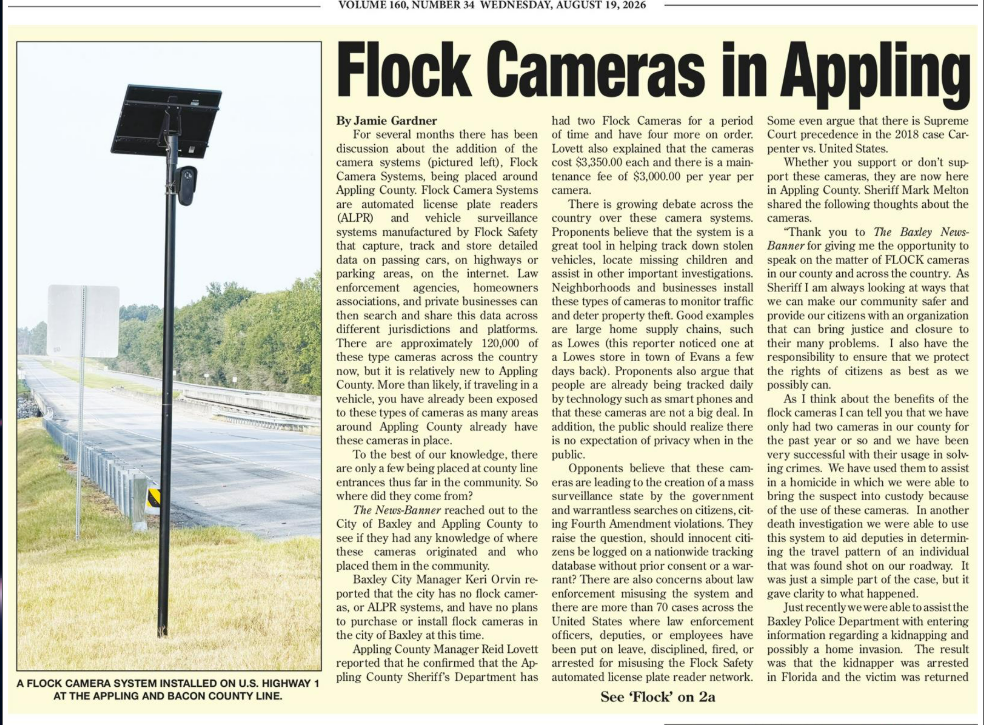
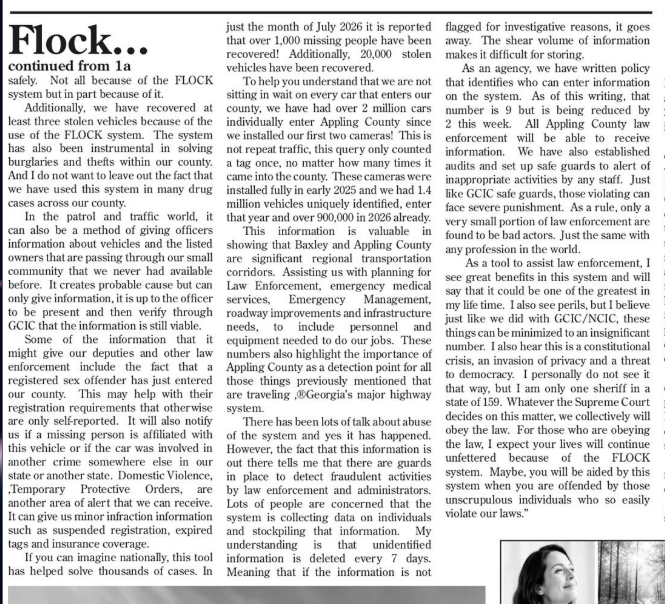
Published official statements are attributed to the newspaper. They are not verified invoices, current permissions, or a record of everything the reporter was told. The article’s opening describes months of discussion; it does not establish a first-public-disclosure date.
R5 · April 2025 audit record and provenance
Mount_Prospect_IL_PD_Network_Audit_4_16_2025_5_1_2025.csv, MuckRock request 186694. Source record 245726 (header = record 1): Appling County GA SO; April 22, 2025, 15:44:15 UTC; reason “Investigation”; 6,248 networks; 80,271 devices.
- Read the preserved four-row derived extract
- Read the preserved source and reconciliation notes
- Open the original public file listing
The earlier September 26 review recorded original-file reconciliation. This preview re-read the retained extract. It establishes an agency-attributed search, not first use, camera activation, operator identification, continuous use, query results, or misuse.
R6 · Have I Been Flocked — dated Appling snapshot
Live browser refresh October 3, 2026: 768 unique searches; April 22, 2025–July 20, 2026; 538 labeled no case number. 538 ÷ 768 × 100 = 70.052083…%, rounded to 70.1%.
- Read the live statistics
- Read the live audit list and coverage explanation
- Read this preview’s verification notes
The page warned that an import was in progress. Its agency explanation identified August 8 as the latest agency-record import. Searches are performed by Appling, generally visible nationwide queries in released third-party logs; this is incomplete and not independently reconciled in full. Missing fields are not adjudicated violations. The displayed dates precede the supplied policy; that policy is not applied retroactively here.
R7 · Institute for Justice — Georgia incident entries
Live browser filter verified October 3: Georgia; All types; 82 incidents shown. Camera fields counted in the filtered list: 81 Flock + 1 Unspecified = 82.
Open the IJ database and select Georgia
This is the publisher’s incident catalog, with differing allegations and outcomes. It is not an official statewide count of arrested officers, convictions, or independently adjudicated events. A current total of 73 arrested and charged Georgia officers was not confirmed.
R8 · Official GBI announcements
Four official announcements, rechecked October 4, 2026.
- July 6 – five former Albany officers; reported internal-audit finding
- September 2 – Clayton County deputy; preliminary information
- September 14 – former Colquitt County deputy; preliminary information
- September 30 – former Hall County investigator; audit and preliminary information
The Albany release expressly says an internal audit revealed repeated use of retained Flock plate data for non-law-enforcement purposes. The Clayton, Colquitt, and Hall releases describe preliminary information indicating non-law-enforcement use or access. These distinctions are retained in the article.
Read the revision source notes
These announcements establish arrests, charges, and the findings or information attributed to investigators. They do not establish convictions or a complete statewide arrest total, and do not establish misuse in Appling.
R9 · Georgia Open Records Act — duties and remedies
- § 50-18-71 — access, timeline, partial production, vendor retrieval, withholding, and existing-record limits
- Judicial Council / AOC legislative update — 2025 retrieval amendment, PDF page 11
- Georgia General Assembly enacted-law summary — Act 276 / SB 12, printed page 53 (PDF page 63)
- § 50-18-73 — court enforcement and attorney’s-fee criteria
- § 50-18-74 — civil and criminal penalty criteria
Code reproductions checked in this conversation. The 2025 retrieval amendment is also supported by state publications; the older AG-posted Act PDF omits it. “Timeline” is the statute’s language; the October 7 and 9 dates are requester demands. Compliance analysis is not a court ruling. Penalties and fee awards require applicable findings; no criminal guilt or automatic award is declared.
R10 · Georgia’s ALPR statute
O.C.G.A. § 35-1-22 — use, sharing, policies, training, and captured-data disclosure exemption
Subsection (e): deploying agencies must maintain use-and-operation policies, including policies for officer training in the use of captured plate data consistent with the statute. The provision supplies no post-deployment grace period. Subsection (f): captured plate data is exempt from public disclosure under the Open Records Act.
The deployment-and-operation timing discussion is a reading of the statutory text; it does not literally contain a prior-to-activation deadline. The office’s policy-history statement and earlier documented activity raise an unresolved compliance question, without establishing the absence of every broader policy or an adjudicated violation. Subsection (e) does not expressly require webinar attendance-record creation; a separate violation for missing attendance records has not been confirmed. Procurement and governance records are distinguished from unrestricted raw plate data.
R11 · Flock’s descriptions of capability and control
- Flock FAQ — search filters and audit information
- Flock Press Center — point-in-time captures, roles, and customer sharing controls
These are vendor descriptions, not independent verification of Appling’s configured permissions, retention settings, or actual practice. A camera sighting does not identify the driver or trip purpose and does not establish uninterrupted tracking.
R12 · Sheriff’s constitutional position and county budget authority
- Channell v. Houston (2010) — independent constitutional office
- Chaffin v. Calhoun (1992), 262 Ga. 202–204 — duties and county budget powers
Independence in the exercise of official duties does not mean an absence of all budgetary, judicial, or statutory accountability.
R13 · Equipment laws and the opening comparison
- § 40-8-23(d) — rear registration-plate illumination
- § 40-8-73(e) — windshield starburst or spider webbing greater than three inches by three inches
- Draper v. Reynolds, 369 F.3d 1270 (11th Cir. 2004) — tag-light stop and probable-cause analysis
The opening is conditional on an actual legal violation. A small chip alone is not established as a violation by the cited windshield provision. This is not an assertion about an identified Appling equipment stop.
R14 · Primary opinions for the hypothetical stop discussion
- Illinois v. Wardlow, 528 U.S. 119, 124–125 (2000) — location alone and reasonable suspicion
- United States v. Arvizu, 534 U.S. 266, 273–277 (2002) — total circumstances
- Whren v. United States, 517 U.S. 806, 810–813 (1996) — traffic grounds and investigative motive
- United States v. Baker, No. 23-8042 (10th Cir. July 23, 2024), majority pages 3 and 18 — 50-mile observation and affirmed result
- Rodriguez v. United States, 575 U.S. 348, 354–357 (2015) — duration and mission of a traffic stop
- Knowles v. Iowa, 525 U.S. 113, 116–119 (1998) — citation does not alone authorize a full search
- Florida v. Bostick, 501 U.S. 429 (1991) — consensual questioning and search requests
- Maryland v. Dyson, 527 U.S. 465, 466–467 (1999) — automobile exception
- Kentucky v. King, 563 U.S. 452 (2011) — warrant principle and exceptions
- Berkemer v. McCarty, 468 U.S. 420, 434–442 (1984) — ordinary traffic stops and Miranda
The scenario is hypothetical. These decisions do not decide the exact Flock-history scenario, establish Appling’s practices, or resolve every constitutional question about ALPR use. Baker’s dissent is not presented as the holding.
R15 · October 3 separate completion demands
Request 1 sent at 6:42 p.m. Eastern; Request 2 sent at 6:44 p.m. Eastern. Both addressed separately to the records office and Sheriff Melton. Both seek rolling production and the October 7 / October 9 schedule.
Approved outgoing wording and sent-copy verification are distinguished from recipient delivery or acknowledgment. Private mailbox links, personal email addresses, and screenshots are not included. Historical draft-file labels do not supersede the documented sends.
R16 · Review methods, calculations, and limits
Read the review methods and verification notes
One bounded Gmail account review; retained source package; visually inspected production and newspaper pages; re-read audit extract; dated public-source checks. No claim of a complete agency-record universe, live system audit, adjudicated wrongdoing, or complete statewide arrest total.
R17 · Flock’s public denial of movement tracking
Flock public article: introduction, Key Points, and the Claim/Fact discussion of tracking. Live text checked October 3.
This is the vendor’s position, including its legal characterizations. This article does not adopt its claim that every ALPR use is constitutional.
R18 · Observed operation and Flock training
Brendan Keefe, InvestigateTV, June 15, 2026: training videos; Condor demonstration; spokesman’s responses.
Read the firsthand investigation
Condor is distinct from ALPR equipment. No Appling deployment is established.
R19 · Camera examination and Flock security notice
WIRED/404 Media, September 16, 2026: recovered media, extracted-model tests, facial-recognition limitation, and company response. Flock security notice: “Ongoing Security Reinforcements” paragraph about physical access and footage. Live sources checked October 4.
Review source locators and research limits
The article distinguishes capture, storage, customer access, detection, and identification.
R20 · OS Investigate interface research
WIRED, August 19, 2026: reconstructed interface, prompts, and Flock’s development-status response.
Read the software investigation
Interface evidence does not establish operational success or Appling access.
R21 · Earlier DOT approval and repeat public-notice search
Georgia DOT approval workbook, released May 22, 2025: Tab 1, A1:F1 headers and A89:F89 Appling entry. Permit ALPR-001-000001-5; two cameras; approval October 2, 2024. Vendor not identified.
- Read the May 22 GDOT release correspondence
- Open the native DOT approval workbook
- Open the official county meeting archive
- Read the searched-source list, findings, and limits
Twenty-four linked county meeting PDFs totaling 113 pages were OCR searched, with four targeted visual checks. No Flock or plate-reader discussion was located in that scope. The search does not prove an absence of consultation, private notice, unrecorded discussion, or earlier disclosure elsewhere. The DOT entry does not establish vendor, installation, activation, or local notice.
R22 · United States v. Melisa Susan Kyle — opinion and order
Northern District of Oklahoma, No. 4:26-cr-00189-SEH, ECF 62, Judge Sara E. Hill, filed October 1, 2026. Printed pages: 2–4 (sequence and reasons), 10–11 (traffic basis), 25–29 (extended detention), 29–30 (contrary decisions), 34 (historical scope), 37–38 (holding and suppression). Native 38-page PDF read October 4.
- Read or download the preserved court order (PDF)
- Open the CourtListener RECAP copy
- Read the supplied Law Commentary report
Review acquisition details and research limits
A ruling on this record, with contrary decisions acknowledged. No later docket disposition or filed appeal has been confirmed in this review. It is not treated as a nationwide ban or a finding about Appling.
R23 · Corrected reporting on minor-offense search logs
Sam Biddle, The Intercept, September 9, 2026, corrected September 10 at 2:46 p.m. Eastern. Locators: Plano deputy-chief clarification, Norcross and LaGrange examples, case-number discussion, and final correction. The original publisher page was read October 4.
Reported records and scopes are attributed to the original reporter. The full underlying log set was not independently reconciled. Searches are not counts of cameras, people, arrests, or successful matches. Missing case numbers do not alone prove unlawful use; none of these examples establishes Appling practice.
R24 · ACLU analysis and dated standard contract terms
Jay Stanley, ACLU, April 16, 2026; archived February 16 standard terms, section 4.1 on printed PDF page 5 and section 5 on page 6; current Flock terms marked August 21, sections 4.1 and 5. Sources read October 4.
- Read the supplied ACLU contract analysis
- Read the preserved February standard terms (third-party archive PDF)
- Open the February archive source
- Read Flock’s current terms
Review version and acquisition limits
The ACLU is an advocacy source; its analysis is attributed and checked against dated text. The February PDF is a third-party archive, not a certified company or county record. Neither version establishes the terms Appling accepted. Data-use licenses must be read with deletion and other provisions; absence of an earlier no-sale clause does not prove a sale.
8. Update Log
- September 26, 2026: Earlier preliminary report and source package prepared.
- October 3, 2026: The current review checked the requests, responses, policy, newspaper pages, preserved audit extract, dated public figures, and bounded mailbox findings. The two separate follow-up demands were subsequently sent and their sent copies verified. [R1] [R2] [R3] [R4] [R5] [R6] [R7] [R15] [R16]
- October 3, 2026 — explanations added: The current article clarifies the company’s capability claims, the Sheriff’s independence, the earlier public-record lead, the policy requirement, the training-documentation gap, and the limits on each finding. [R9] [R10] [R12] [R17] [R18] [R19] [R20] [R21]
- October 4, 2026 — public trust and Georgia misuse: Made the documented production-timeline failure explicit and brought Georgia’s official misuse investigations into the central argument about verifiable safeguards and public trust. Rechecked the GBI announcements and added the Clayton and Colquitt examples. Kept audit findings, preliminary information, arrests, charges, convictions, and unresolved Appling questions distinct. Local mailbox findings remain bounded to the October 3 review. [R1] [R2] [R8] [R9] [R16]
- October 4, 2026 — capability evidence and constitutional review: Expanded the comparison with WIRED’s device examination and Flock’s security notice. Read the native 38-page Kyle opinion and order, added page-specific references, and connected the documented sequence to the pretext concern. Added questions about travel-history standards and search-reason checks. Device findings remain distinct from Appling’s unconfirmed configuration; the court order remains distinct from a nationwide ban or an Appling finding. [R11] [R19] [R22]
- October 4, 2026 — reported minor-offense searches: Followed the supplied Cybernews article to The Intercept’s original report and September 10 correction. Added its reported Georgia examples and kept searches, network scope, people, and successful matches distinct. The report’s underlying complete log set was not independently reconciled in this review. These examples do not establish Appling’s practices or an unlawful search in every reported case. [R23]
- October 4, 2026 — contract terms: Checked the ACLU’s April analysis, a third-party archived copy of the February 16 standard terms, and Flock’s current terms marked August 21. Identified later changes without treating either online version as Appling’s executed agreement. The actual local contract and amendments remain outstanding in the reviewed correspondence. [R1: S1] [R24]
- Publication: October 4, 2026. Later records or corrections will be identified with their dates and sources.