Who Governs What?
C.L.O.C.K. Civic Education | Revised edition | September 27, 2026
On this page
- Start with the decision
- One geographic county, separate governments
- What does county seat mean?
- Countywide describes an area, not a single operator
- County government includes distinct elected offices
- Read the city’s own governing documents
- Where the governmental tracks connect
- Keep the roles separate
- Permanent jurisdiction labels
- The eight-question checklist
- Worked example: identify the roles
- Follow the records as well as the service
- Next: How Services Actually Work
- Find the next record
- Sources and boundaries of this edition
Understanding Local Government in Appling County
Start with the decision
Imagine a repair to a public facility. Before asking who paid, identify who owns it, who approved the repair and what gives that body authority. The series follows one fictional repair exercise through these questions; its governments, records and figures are invented.
This series teaches a way to investigate, not a complete current service or contact directory. Start with the eight questions in Module 1. Later modules focus on the service, participation and money parts of that same checklist.
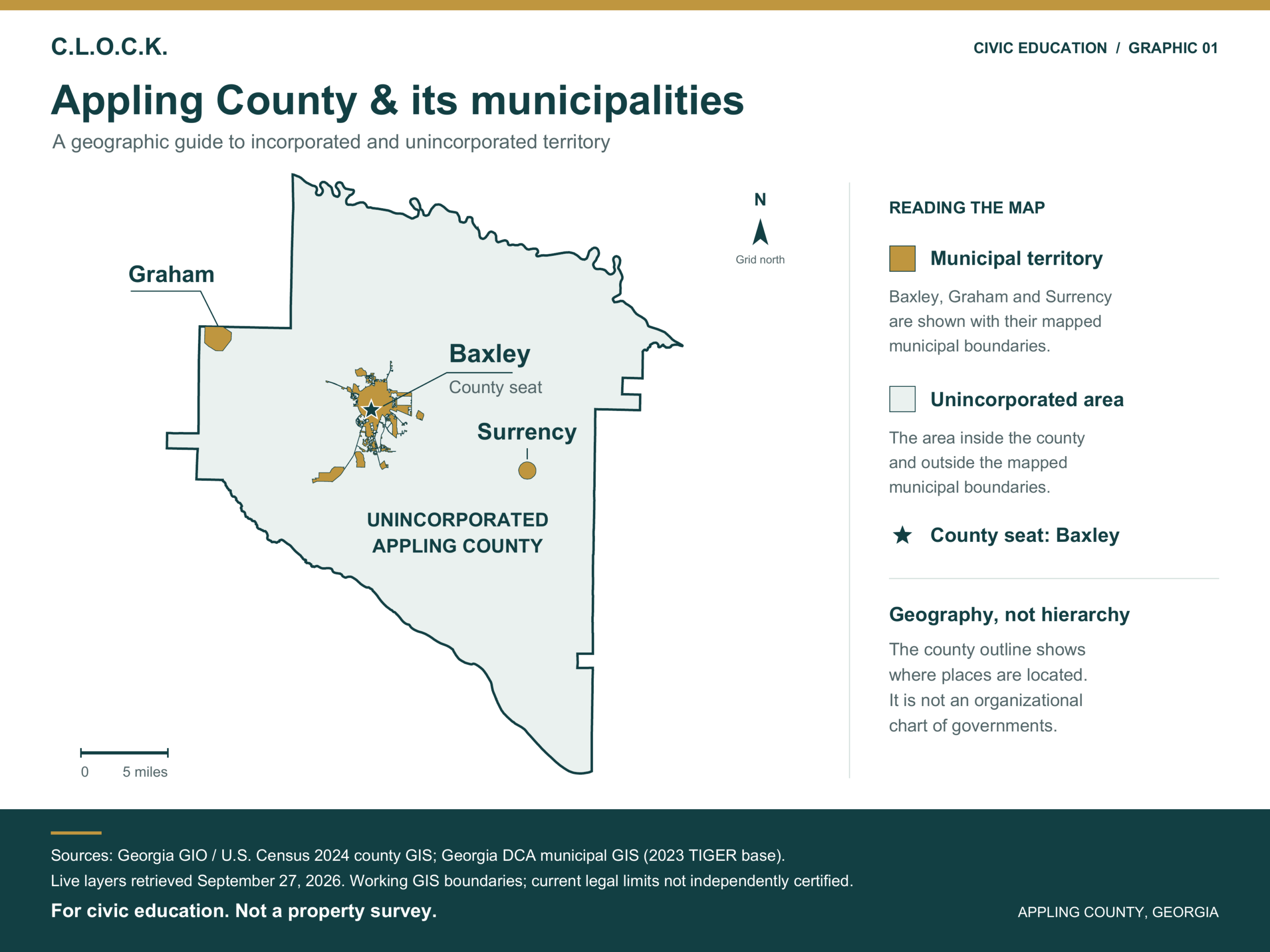
The map shows geography, not responsibility for a particular action. Boundary limit: the qPublic municipal-overlay cross-check is incomplete, and every legally effective municipal change is not confirmed. Read the map source record. This is civic education, not a property survey.
Our local framework is Appling County | Baxley | Graham | Surrency | Shared / Authorities.
One geographic county, separate governments
Geographic Appling County includes Baxley, Graham, Surrency and unincorporated territory. “Appling County government” identifies the county-level government. Those two meanings are not interchangeable. [1][2][3]
Incorporated territory is inside a municipality’s limits. A person living there is both a city resident and geographically an Appling County resident. Unincorporated Appling County is the territory outside all three municipal boundaries. Location helps frame a question; it does not answer every question of responsibility. [1][4]
What does county seat mean?
Baxley is Appling County’s county seat: the place serving as the seat of county government. That designation does not make Baxley city government the government of the whole county or the governing city over Graham and Surrency. County and municipal authority must be examined separately. A city is not a county department. [8][3]
Countywide describes an area, not a single operator
For this guide, “countywide” means across the county, including incorporated and unincorporated areas. It does not, by itself, mean that County government alone operates, funds or controls a service. Service-delivery records distinguish the area served, provider and funding arrangements. [4][5]
County government includes distinct elected offices
Georgia’s Constitution separately identifies elected county officers, including the sheriff, probate judge, superior court clerk and tax officers, and places limits on county home-rule action affecting elective county offices. Do not assume every county office is an ordinary department under the county commission. Identify the office and its governing law. [3]
Read the city’s own governing documents
A municipal charter helps establish a city’s organization and powers. Before assigning a particular decision to a mayor, council, administrator or department in Baxley, Graham or Surrency, check that city’s current charter, amendments and applicable law. This module does not claim to have verified each city’s current internal allocation of powers. [10]
Where the governmental tracks connect
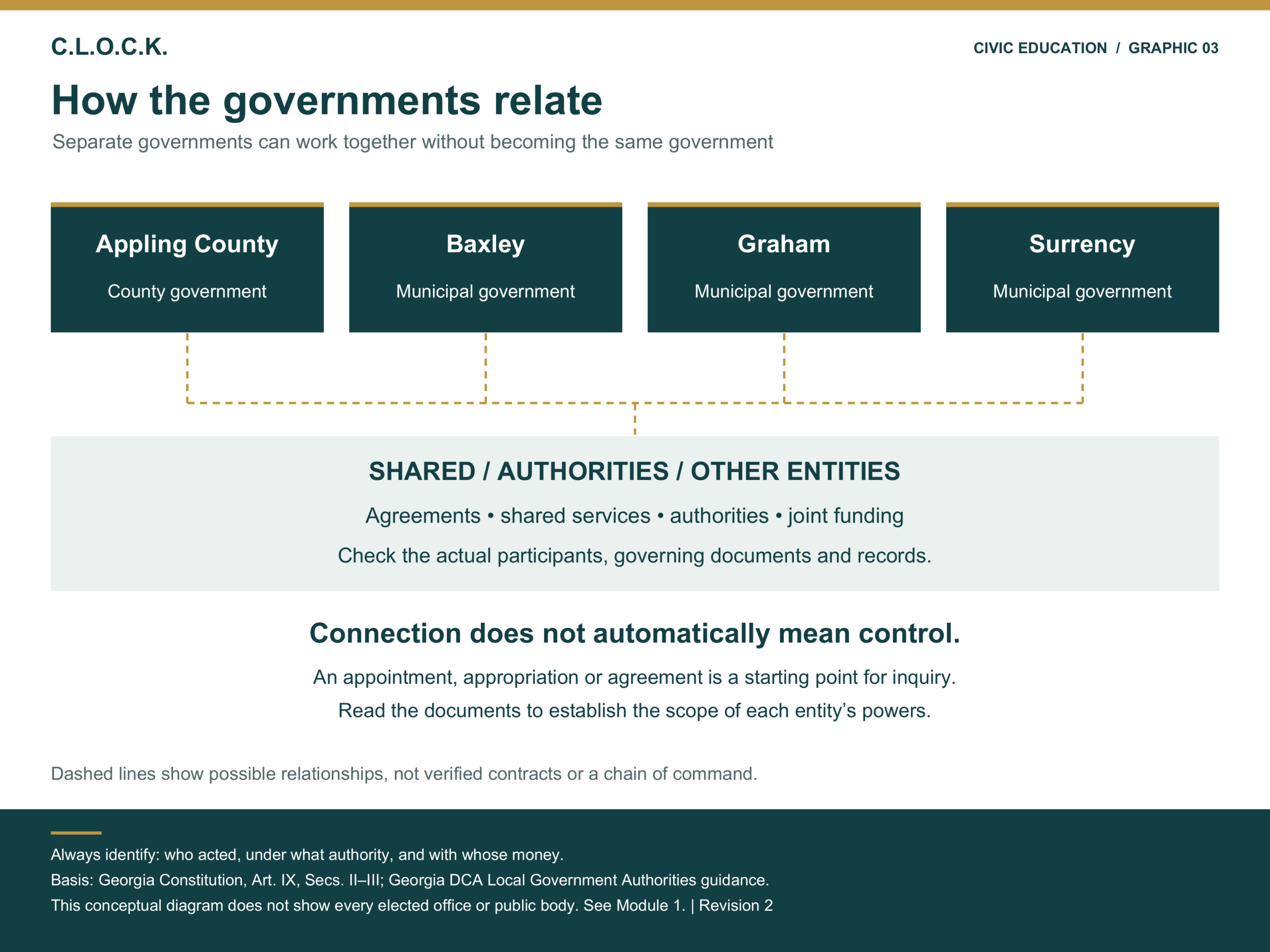
DCA describes local authorities as separate entities for particular public purposes, with different creation methods and dependent or independent relationships. Development, hospital, housing and downtown development authorities are examples of authority types; a type name alone does not establish a specific entity’s powers. [6]
Connection does not automatically mean control. Treat an appointment, appropriation or shared project as evidence of a relationship to investigate, not as a complete answer about legal control. Read the enabling law, charter, bylaws, appointment provisions and relevant ordinances, resolutions, contracts or agreements. This is CLOCK’s research method, informed by the different authority arrangements described by DCA. [6]
Keep the roles separate
Use these distinctions as a research checklist. One entity may fill several roles; establish each answer from the relevant record.
Geography: where the issue occurs. Jurisdiction or legal authority: who has power to act on this issue. Service provider: who performs the work. Funder: where the money comes from. Decision-maker: who made the particular decision. Records custodian: who maintains the relevant agency records.
Do not infer jurisdiction solely from geography, the provider solely from jurisdiction, the funder solely from the provider, the decision-maker solely from the funder, or the custodian solely from the decision-maker. These are CLOCK teaching distinctions, informed by the separate service-area, provider and funding fields in DCA guidance and the Attorney General’s records guidance. [5][7]
Permanent jurisdiction labels
APPLING COUNTY — primarily concerns County government.
BAXLEY — primarily concerns City of Baxley government.
GRAHAM — primarily concerns City of Graham government.
SURRENCY — primarily concerns City of Surrency government.
SHARED / AUTHORITY — involves multiple governments, an authority or a shared arrangement.
VERIFY JURISDICTION — available information does not yet establish responsibility reliably.
These are CLOCK editorial labels, not official legal classifications. Apply a label to the issue being discussed, and explain any overlapping roles.
The eight-question checklist
Use this master checklist throughout the series. Keep a source title, date and page or section beside each answer. Use VERIFY JURISDICTION when responsibility remains unsupported.
1. Where is it? Baxley, Graham, Surrency, unincorporated or multiple areas?
2. What is the issue? Name the service, decision, project or transaction.
3. Which entity has authority? Identify the government, office, authority or other entity.
4. Who actually acted? Identify the exact body, official, department or board.
5. What gives them authority? Locate the governing law and applicable documents.
6. Who provides the service? Identify the actual operator or service provider.
7. Who pays? Trace the funding source and any transfers.
8. Who has the records? Identify each relevant agency and records custodian.
For question 5, start with the Constitution, state law, local legislation or enabling law, then examine the applicable charter, ordinance, resolution, agreement, contract or adopted policy. Read subordinate documents within the authority allowed by governing law; a document’s title alone does not establish a power. [3][10]
Download the matching checklist graphic. The text above is the complete accessible checklist.
Worked example: identify the roles
The fictional repair records support these answers:
| Question | Answer from the invented records |
|---|---|
| Where and what? | A repair to a City B-owned facility inside City B (F1). |
| Who may decide? | City B council may authorize the repair (F1). |
| Who acted? | City B council approved the allocation and amendment (F3). |
| What gives authority? | The fictional governing rule in F1; the agreement assigns project duties in F2. |
| Who provides the work? | The repair contractor under the signed contract (F4); City B manages the project (F2). |
| Who pays? | The revised allocation is $40,000 from County A plus $80,000 from City B (F2). Receipt and payment are separate questions. |
| Who holds records? | City B holds project records; County A holds its contribution records (F2). |
City B's authority and County A's contribution answer different questions. The facts supplied do not show that the repair is complete.
Follow the records as well as the service
The Georgia Attorney General advises directing a records request to the agency’s records custodian and recommends making it in writing. For a project involving several entities, identify the records held by each rather than assuming one office holds everything. [7]
For a real project, seek the corresponding approval, agreement and financial records; do not assume they match the fictional exercise.
Next: How Services Actually Work
Continue to Module 2: How Services Actually Work. It focuses on service areas, providers, funding and decision authority from the same checklist.
Find the next record
Use the source-finding guide for document types, official starting points and unresolved local source limits.
Sources and boundaries of this edition
Reviewed September 27, 2026. This is civic education, not a complete service directory or a determination of responsibility in a particular dispute.
Graphic 1 uses the documented GIS layers. Its municipal layer is a working state dataset based on 2023 TIGER with submitted updates; the county layer is 2024 TIGER. I cannot confirm that every legally effective municipal change is included. The qPublic parcel-map boundary cross-check remains incomplete. The map is for civic education and is not a property survey. See the Graphic 1 source record. [1][8]
1. Georgia GIO county and municipal GIS. Graphic 1 uses the 2024 TIGER county layer and DCA Municipalities_v3. See the accompanying Graphic 1 source record for exact layer URLs, metadata and comparison findings.
2. Appling County Service Delivery Strategy, 2022. PDF p. 2: participating entities and services; PDF pp. 3-5: fire-protection arrangement, funding and map. This is a dated record, not independent confirmation of present operations.
3. Georgia Constitution, revised July 2025. Art. IX, Sec. I, Para. III (county officers); Sec. II, Paras. I-III (home rule and powers); Sec. III, Para. I (intergovernmental contracts). PDF pp. 80-85, 87-88; printed pp. 72-77, 79-80.
4. DCA Service Delivery Strategies. Overview of service-delivery arrangements, funding equity and coordination among governments and authorities.
5. Georgia SDS rules, effective January 1, 2026. Rules 110-12-9-.01(1), -.02(2) and -.04: scope, SDS contents and submission documentation. DCA verification is not approval of substantive arrangements.
6. DCA Local Government Authorities. Sections Overview of Registered Local Government Authorities, Method of Creation and Authority Operations.
7. Georgia Attorney General: How to Make an Open Records Request. Guidance on directing requests to the records custodian and making requests in writing.
8. Appling County Board of Assessors / qPublic. Landing-page county-seat identification. Parcel-map boundary cross-check was not completed; see Graphic 1 source record.
9. DCA Appling County SDS document index. The latest document listed on the retrieved index was dated 2022. This does not establish that no other amendments or agreements exist.
10. Georgia Municipal Association: City Charters. Municipal association guidance on charters, local acts and municipal organization. Read each city’s current charter and amendments before assigning a specific power.